

LaFarge Stained glass Window Restoration
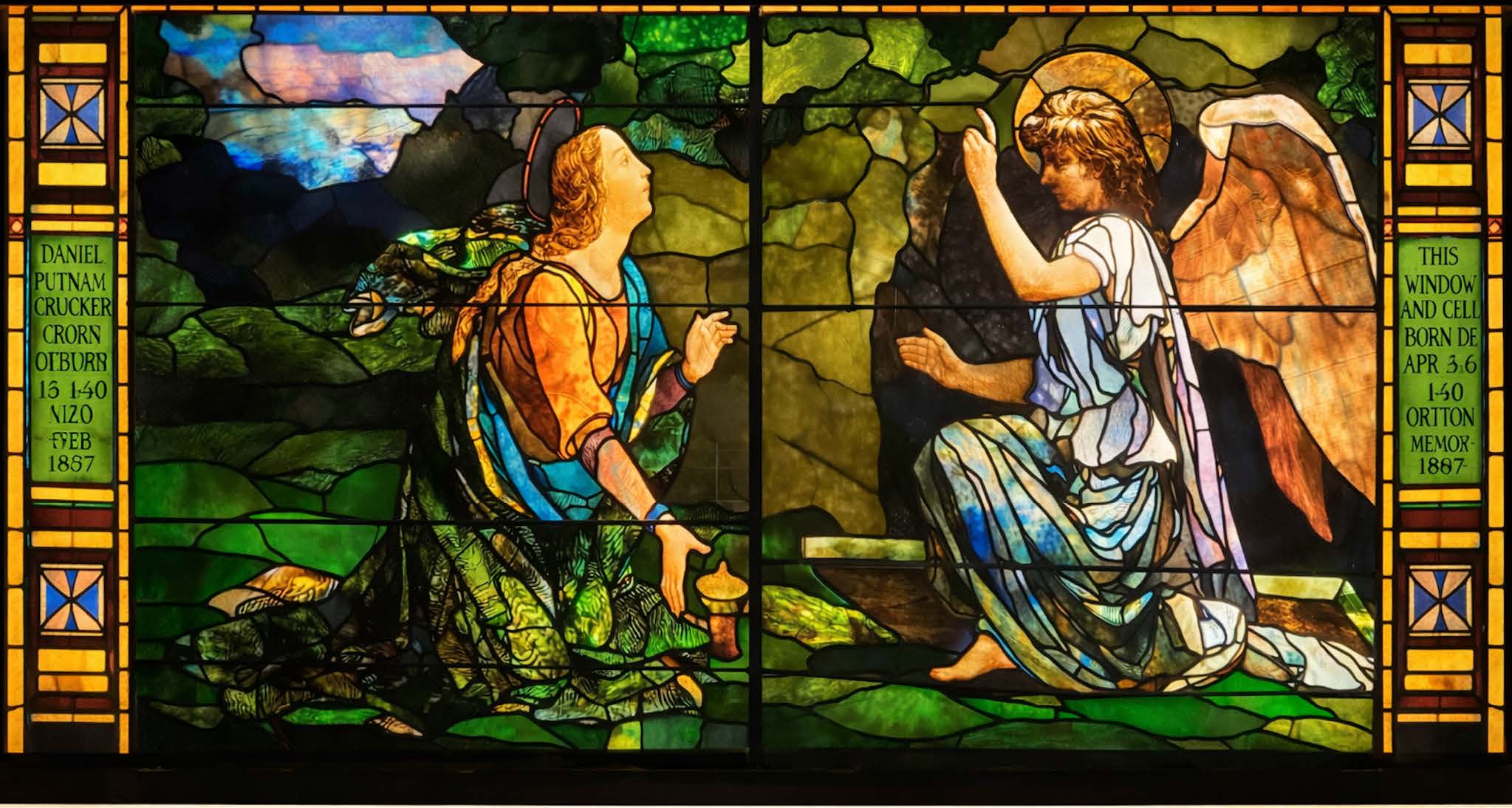
An Angel and Mary Magdalen at the tomb of the risen Christ = John 20:11–18. A chalice is Mary Magdelene’s attribute.
Window = Magdalen at the Tomb of Christ, Daniel Putnam Crocker Memorial Window, from Parish House, Christ Church Cathedral, Springfield MA, completed and installed in 1889. (See: LaFarge Exhibition catalog, James Yarnall, raisonne, inventory.)
The story of this window began not in a church, but on the worktables of the studio—fragmented, fragile, and full of unanswered questions. When the panels first arrived, they were barely holding together, and their layered construction was difficult to interpret. It was immediately clear that this was not an ordinary stained-glass window. Its unusual configuration suggested a more complex history, and that what we were seeing was only part of a larger story waiting to be understood.
This window represents an important moment in American art history. By the late 1880s, La Farge had already transformed stained glass in the United States through his use of opalescent and layered glass. These innovations allowed artists to create depth, luminosity, and color in ways that had not previously been considered. This window was created during that period, around 1888–1889, when La Farge was rebuilding his career after the closure of his studio.
Despite these challenges, he continued to produce highly original and expressive work.
The window was commissioned as a memorial and installed in 1889 at Christ Church Cathedral in Springfield, Massachusetts. In its original setting, it functioned as part of a sacred interior, designed to interact with light and architecture while supporting reflection and devotion. The subject—Mary Magdalen at the tomb—reflects themes of discovery, transformation, and spiritual awakening, ideas that La Farge explored throughout his work.
At some point in the twentieth century, the window was removed from its original location. Separated from its architectural context, it gradually lost both its identity and attribution. Stored in crates for many years, it remained unrecognized as a work by La Farge. Without clear documentation, its significance was obscured until careful research undertaken during this project brought its history back to light. This process proved particularly compelling, as each stage of investigation revealed new information and helped reconstruct the story of the window.
From the outset, this project presented significant challenges due to its scale, condition, and historical importance. The BAS team approached the work with careful planning, ensuring that every step followed SGAA restoration standards and best practices.
The process began with a thorough initial assessment. When the window arrived at the studio, it was in poor condition and barely holding together. It consisted of four separate panels, which immediately raised questions about its original design. This unusual configuration suggested that the window may have been assembled from two separate compositions, with dedication panels added at a later date.
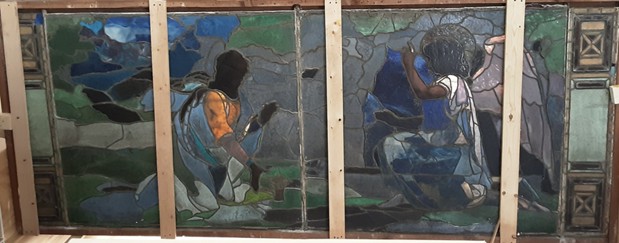
To better understand these uncertainties, the BAS team initiated a focused research phase. Given the complexity of the object, we consulted stained glass and architectural historian Rolf Achilles. His expertise proved invaluable. With his guidance, we reviewed archival books and catalogs and contacted churches and institutions in an effort to trace the window’s origin. This investigation led to a key discovery: the window was shown in a published volume on the work of John La Farge.
This identification naturally situates the window within the larger context of La Farge’s career. John La Farge was a troubled genius. Born into a French New York City family of considerable wealth on March 31, 1835, the first of nine children, he received a superb bilingual education, became an acclaimed muralist, and developed trend-setting stained glass technology that resulted in a thriving interior design business and brilliantly original stained-glass windows. In the late 1870s and early 1880s he was recognized as a leader among Americans revolutionizing the technical and aesthetic process of stained-glass window production, offering new potential to this ancient art form.
With this historical understanding in place, the BAS team moved into detailed documentation. Full-scale rubbings were created for each panel, as well as for the complete layered system, to accurately record the original lead lines and overall design structure. Due to the complex shapes and multi-layered construction, this step required careful and precise tracking. The window was also thoroughly photographed and measured before any disassembly began.
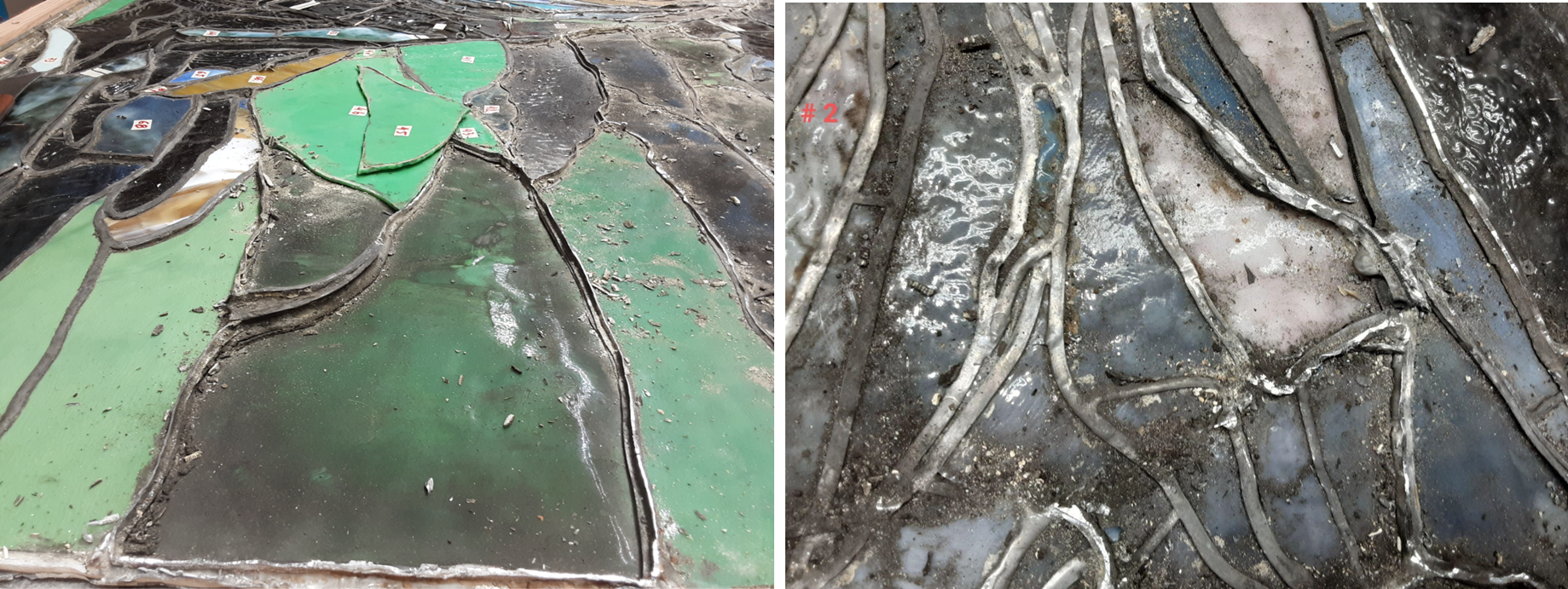
A methodical disassembly was then carried out, with each piece of glass carefully removed, cataloged, and stabilized. At this stage, the condition of the window confirmed earlier concerns: the lead matrix had deteriorated significantly, with flattened cames, separated solder joints, and weakened structural support. While the layered construction created remarkable visual richness, it had also contributed to long-term stress and cracking, particularly in the lower sections where weight and pressure were greatest.
In addition to structural issues, a number of individual glass pieces required conservation treatment. Cracked elements were carefully realigned and bonded using conservation-grade epoxy (Hxtal), allowing for stabilization while preserving original material. This step required precise control, as the optical qualities of the glass—central to La Farge’s design—had to remain visually uninterrupted.
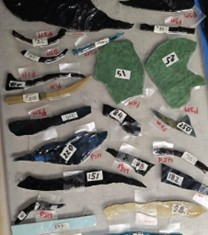
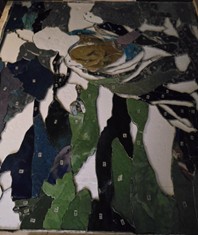
Restoration therefore focused on both structural stability and fidelity to the original design. Each layer of the window was re-leaded and cemented separately to restore strength while preserving the original composition. Based on careful analysis of the original materials, Prism Glass Works fabricated new lead cames to match the historic profiles. A close study of the glass itself further revealed the remarkable complexity of La Farge’s approach, and special attention was given to maintaining precise alignment between layers, as even slight shifts could alter the intended color and light effects.
At this point, it becomes important to understand more fully the artistic and technical environment in which this window was created. Acknowledged as the inventor of opalescent and plated stained-glass windows, John La Farge was also an analytical thinker, an art critic, and the country’s leading muralist. America was ripe for such artistic innovation, and his work in the late 1870s and early 1880s transformed both the technical and aesthetic possibilities of stained glass.
Among the several able craftsmen who worked with the La Farge Decorating Company at its Union Square, New York City operations were John Calvin and English immigrant Thomas Wright. Both were highly skilled stained glass craftsmen. When La Farge made a series of profound business mistakes in 1885, he shuttered his business and sought refuge in travel, especially to Japan.
With the demise of La Farge’s firm, Calvin and Wright, together with artists George Rose and Sidney Smith, formed the Decorative Stained Glass Company. They designed and built their own windows but also offered fabrication services to other artists. Upon his return in 1886, La Farge found that his absence had been filled by other artists, including Louis Comfort Tiffany,
who had surpassed him as America’s foremost glass artist. However, the founding of the Decorative Stained Glass Company by his former collaborators allowed La Farge to continue his window production with a group of exceptionally talented craftsmen and women.
It was during this period of renewed activity that the window under discussion—the Daniel Putnam Crocker Memorial Window—was commissioned, completed, and installed in 1889. That same year, La Farge submitted a figural stained-glass window made with plated opalescent glass to the Exposition Universelle in Paris, where he was awarded a gold medal and recognized as a major innovator.
The window on the BAS work tables was originally constructed using La Farge’s multi-layered technique: a primary structural matrix of lead cames supporting the figural composition, combined with plated interior and exterior overlay systems that enhance tonal depth, luminosity, and optical vibration. In total, the composition functions through a four-layer construction in key passages.
La Farge’s choice of glass was remarkably complex. The figural areas incorporate milky opal glass, translucent amber and violet tones, and streaked sheets that shift chromatically as light passes through them. Many pieces are irregularly shaped, following painterly rather than standard geometric divisions. In areas such as draperies, layered glass is used with great sophistication, creating depth and tonal variation through multiple layers rather than heavy paint.
🟩 This working method is also described in contemporary sources: https://library.bc.edu/lafargeglass/exhibits/show/descriptions/mcmullen
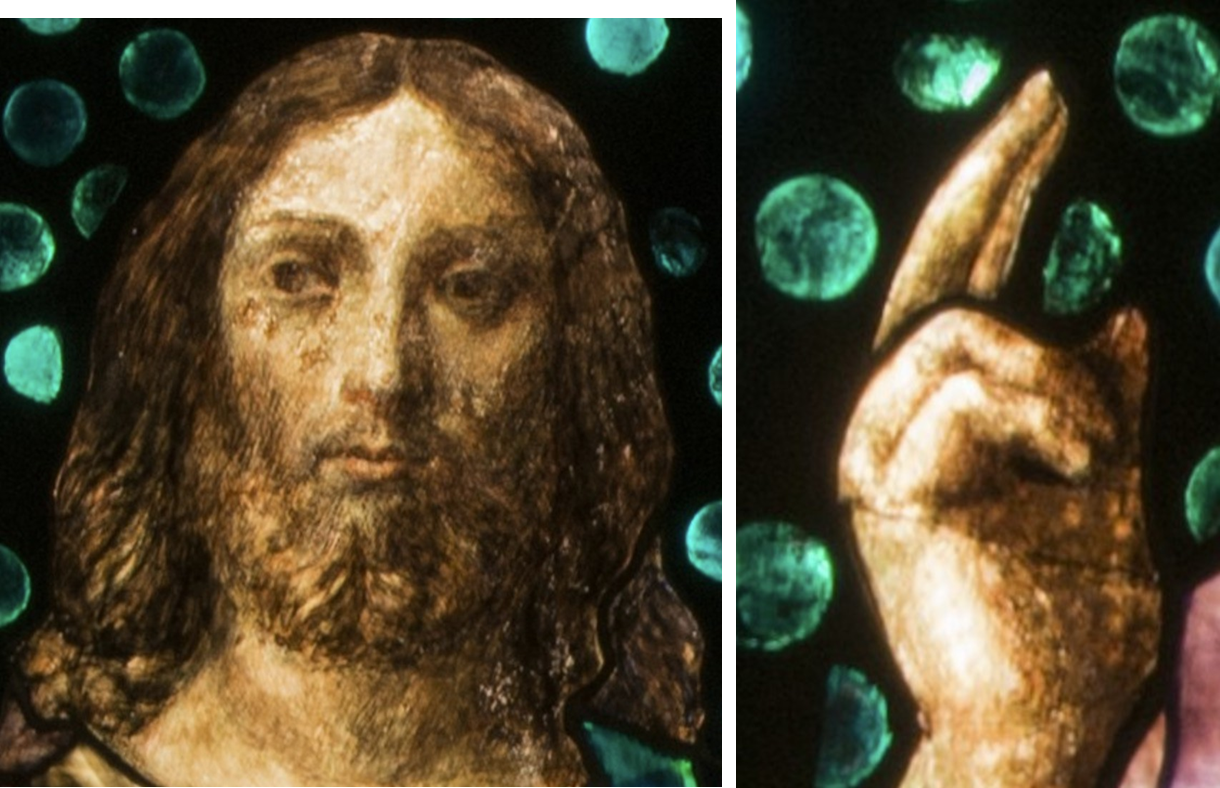
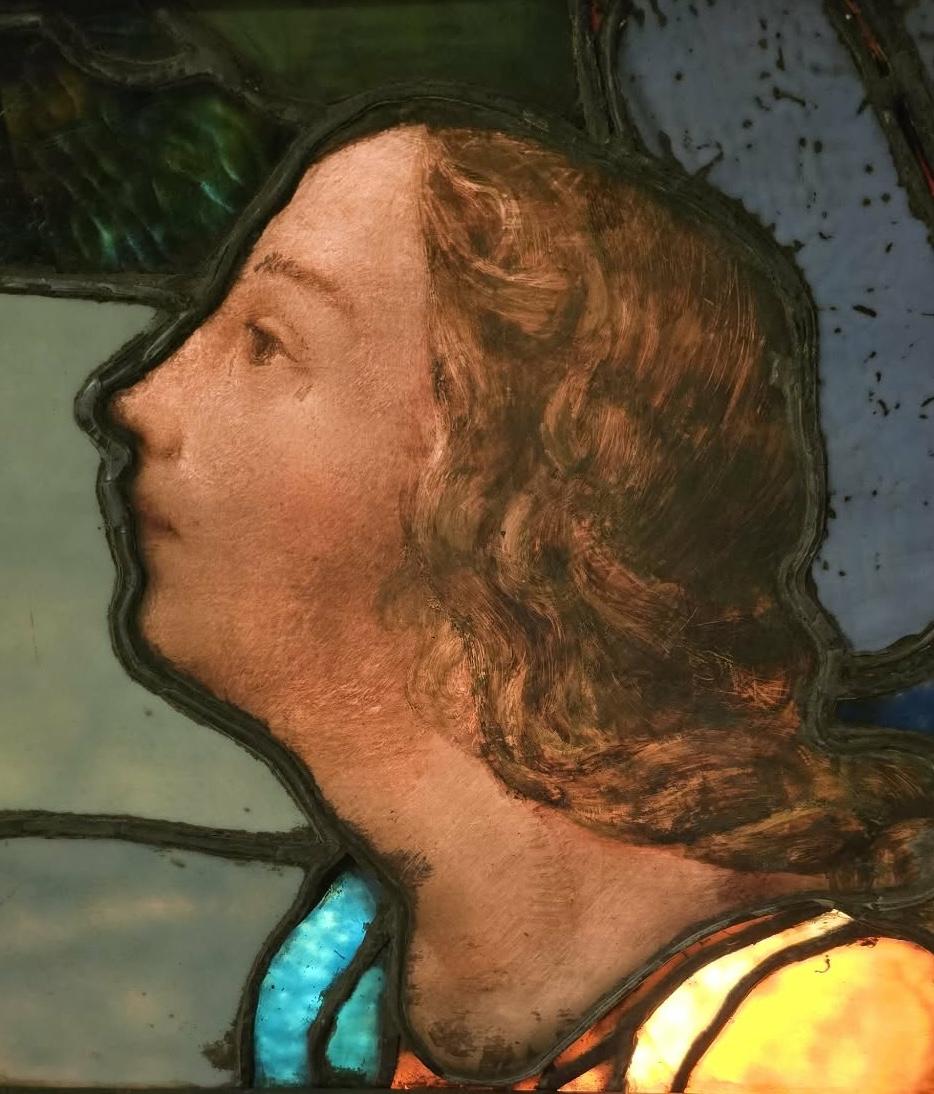
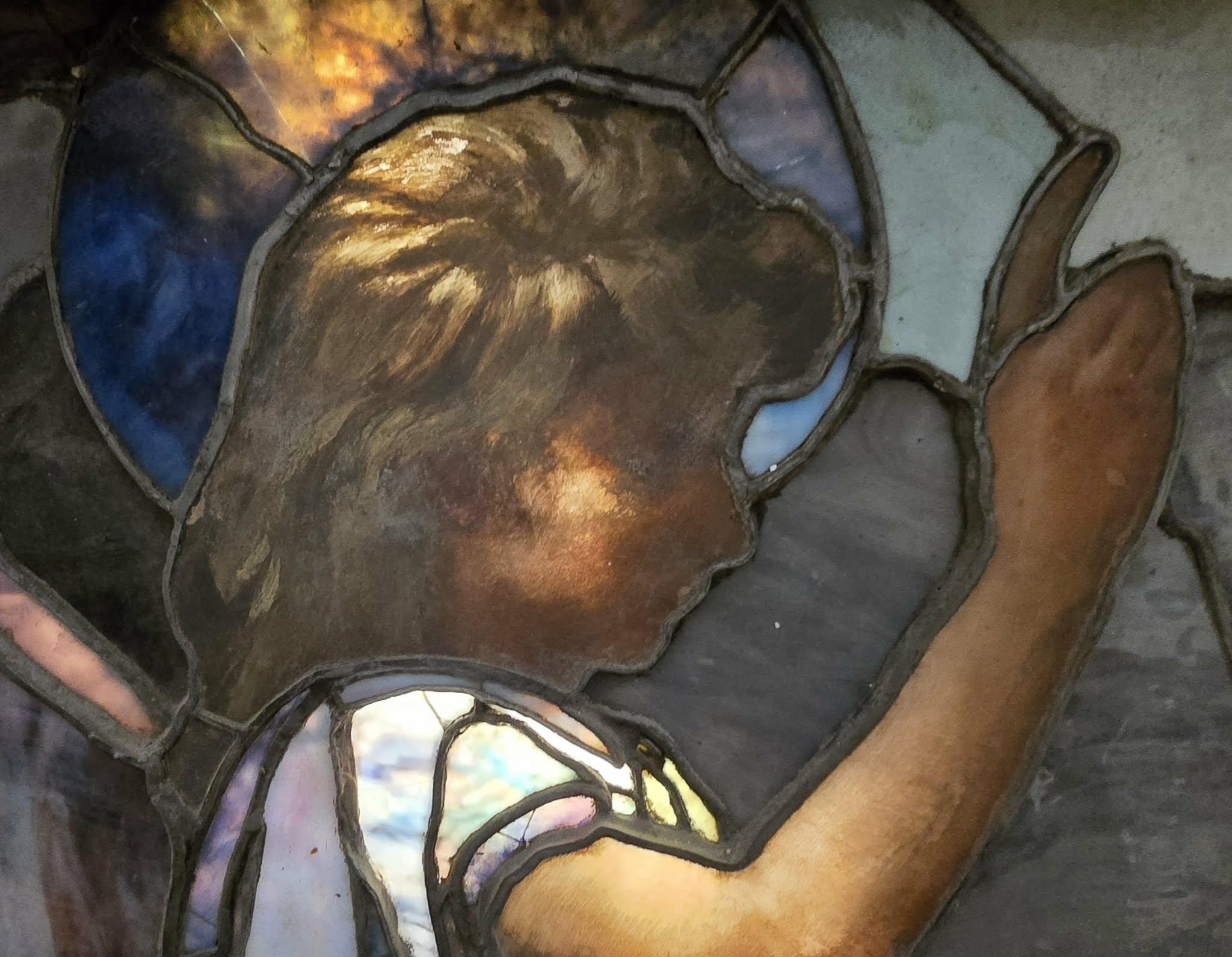
“The faces, hands, and feet of all three figures are painted onto the glass. This part of the project was often assigned to Juliette Hanson, one of La Farge’s key employees. La Farge mentions that in his practice only the ‘flesh’ of a window was commonly painted with enamel on glass… the work became a form of translucent mosaic held together by lead… Only the heads, hands, faces… still continued to be painted.”This observation helps clarify La Farge’s working method and reinforces what is evident in the Crocker window itself: that the visual power of the composition lies primarily in the glass rather than in applied paint.”
At the same time, such layered construction produces extraordinary visual richness but also increases long-term structural vulnerability. Each additional layer adds weight, rigidity differentials, and points of stress concentration. Over time, gravitational forces, lead fatigue, failed cementing, and shifting support ties introduced tension along glass edges, resulting in cracking—particularly throughout the lower registers where weight and stress were greatest.
The final stage of the project—reassembly and installation—proved particularly demanding. Due to the highly irregular shapes of the glass pieces and the complexity of the layered system, alignment during mounting required exceptional precision. Each element had to be positioned in exact relation to the others to preserve both structural integrity and the intended visual effect of light passing through the composition.
Cleaning was therefore approached with restraint. Because much of the visual modeling is inherent in the glass itself rather than applied paint, the goal was to preserve the original surface and character of the material.
In preserving the Daniel Putnam Crocker Memorial Window, one preserves not only a devotional image, but a moment in American artistic invention—when glass itself became painting, and light became theology. The restoration required more than technical intervention; it demanded a careful understanding of La Farge’s layered vision, where structure, material, and illumination are inseparable. From the stabilization of individual glass fragments to the precise reassembly of its complex layered system, every step was guided by the intention to retain both material authenticity and visual depth. The result ensures that the window continues to function as it was conceived—not simply as an object, but as a dynamic interplay of light, color, and meaning.
📞 For restoration projects call us at (773) 526-1127 or
📧 Email us at balticartstudio@gmail.com
With gratitude,
Baltic Art Studio Team